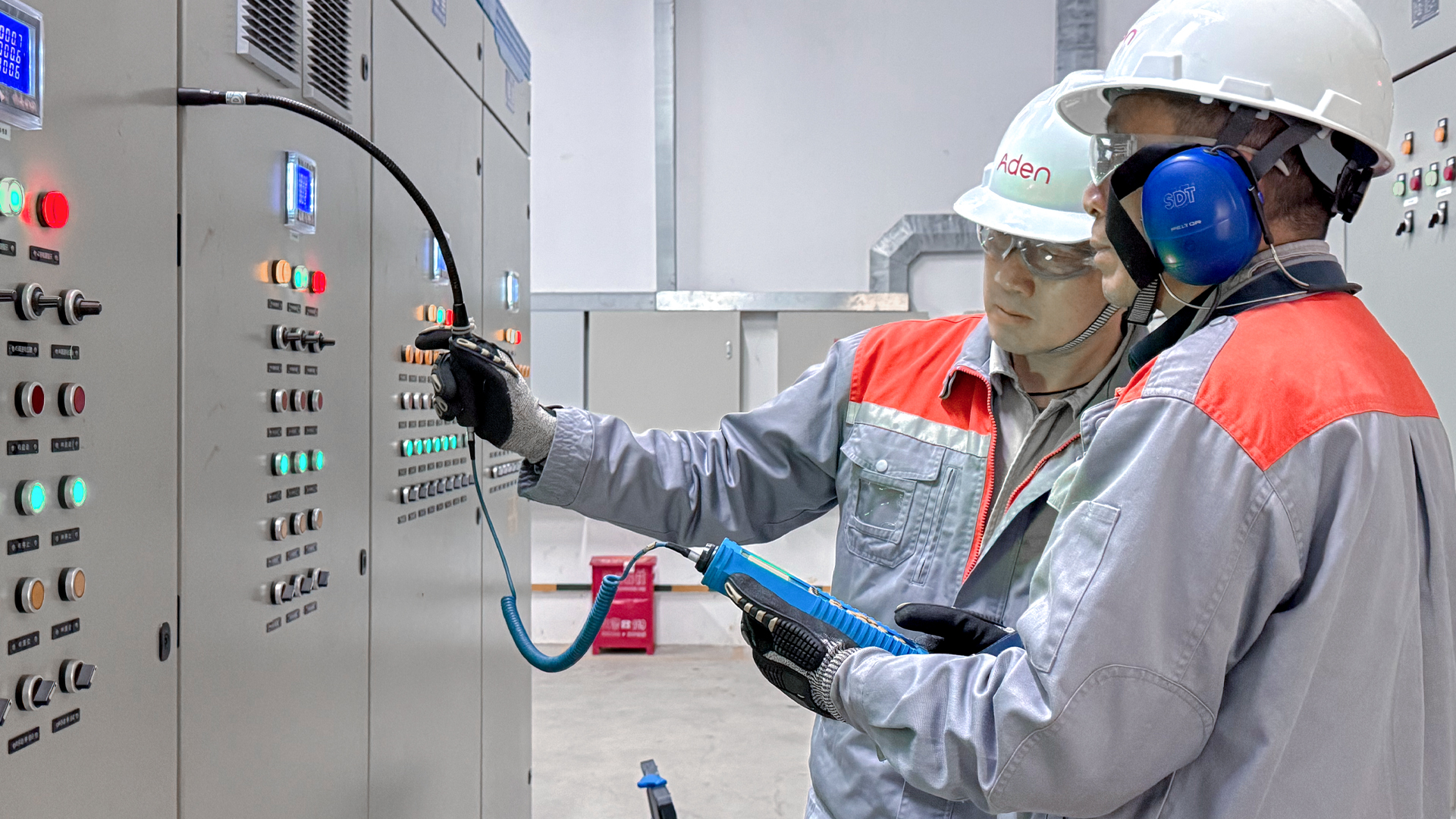
In modern industrial and building operations, the continuous and efficient operation of critical equipment serves as the foundation for ensuring production continuity. Potential equipment faults are often difficult to detect through conventional methods during their initial stages. Without timely intervention, these anomalies can ultimately escalate into costly unexpected downtime.
Aden Predictive Maintenance Services utilize advanced inspection methodologies to capture faint, abnormal equipment signals at an early stage. This feature focuses on the first technology of the series: ultrasonic detection. Through this cutting-edge approach, early warning signals are precisely identified to fully protect equipment performance, operational efficiency, and operational continuity.
Ultrasonic detection: Accurate identification of potential equipment risks
When equipment experiences internal gas leaks, lubrication deficiencies, or early electrical discharge, the acoustic emissions generated typically fall within a high-frequency range, usually exceeding 20 kHz. This frequency spectrum stands beyond the range of human hearing, yet these specific faults are responsible for degrading system efficiency and increasing energy consumption.
Aden’s ultrasonic detection technology captures these high-frequency acoustic emissions to achieve precise fault localization:
- Compressed air and gas leak localization: Compressed air systems account for a significant portion of energy consumption in facilities, meaning minor leaks can accumulate into substantial energy waste. Ultrasonic detection accurately pinpoints compressed air leaks to prevent energy loss.
- Early bearing lubrication anomalies: In the initial phases of mechanical wear, changes in ultrasonic signals appear much earlier than variations in vibration or temperature. This allows for the exact identification of lubrication anomalies, preventing increased friction.
- Early electrical fault resolution: For high-voltage installations such as electrical cabinets and transformers, the technology detects early electrical faults promptly. This eliminates equipment issues at the source, preventing loss of system efficiency and operational reliability.
Supported by real-time operational equipment data, Aden’s professional teams maintain constant awareness of degradation states, accurately forecast potential fault risks, and ensure stable equipment operations.
Akila digital twin platform: Data-driven decision making
Equipment inspection represents only the initial step; the ultimate goal is to integrate this data to guide efficient operations.
Within Aden’s digital transformation ecosystem, all field diagnostic data from ultrasonic inspections can be uploaded simultaneously and integrated into the Akila digital twin platform. Utilizing advanced intelligent algorithms and data analytics, Akila enables the following management workflows:
- Actual status assessment: Equipment condition is evaluated based on actual health indicators, avoiding unnecessary over-maintenance.
- Precise priority alignment: Maintenance tasks are prioritized based on the actual status of the equipment, optimizing the allocation of operational resources.
- Closed-loop process management: Diagnostic data is used to automatically assist in scheduling maintenance plans, achieving a complete loop from risk discovery to resolution.
Proactive maintenance: Total asset lifecycle cost optimization
Implementing Aden’s ultrasonic detection and predictive maintenance model delivers long-term operational benefits to enterprises:
- Substantial energy loss reduction: Eliminating gas leaks and mitigating excessive power consumption caused by abnormal mechanical friction directly aids facility energy conservation.
- Significant mitigation of unexpected downtime risks: Transforming emergency repairs into scheduled, preventive actions ensures production lines and core building systems operate continuously and stably.
- Comprehensive optimization of total asset lifecycle costs: Extending asset operational lifespan comprehensively optimizes overall operational expenditures.